


Software Development

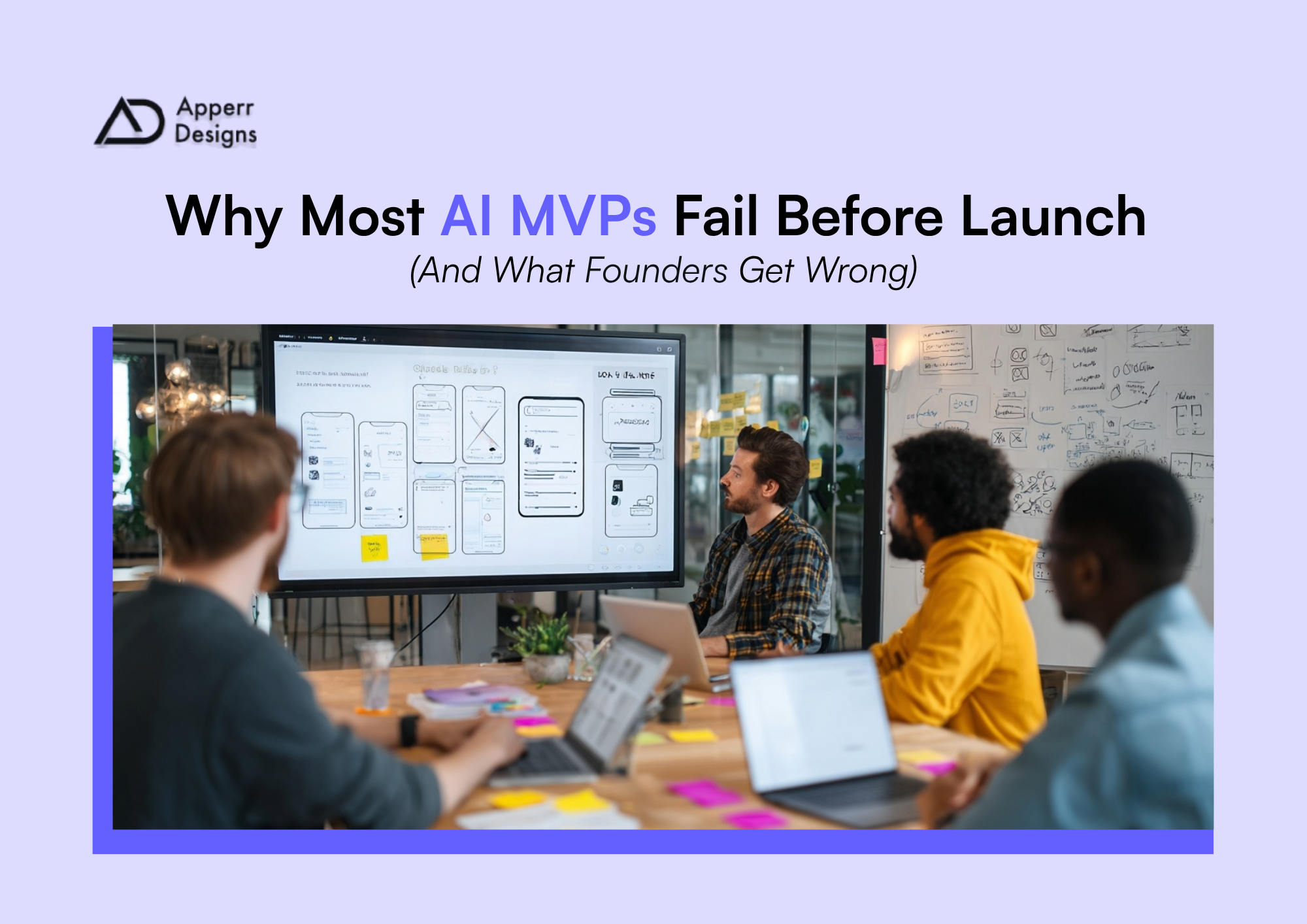

Building an AI MVP has never been easier.
With powerful APIs, cloud AI services, and pre-trained models, startups can turn ideas into working products faster than ever.
Yet, many AI startups never make it to launch or struggle to gain traction after release.
The problem usually isn't the technology. It's the product strategy.
Many founders jump into AI product development without validating the problem they're solving, understanding their users, or defining a clear product roadmap. The result is an impressive demo that customers simply don't need.
If you're planning an AI-powered product, working with experts in AI Agents & AI-Powered Automation can help you validate your idea before investing in development.
In this guide, you'll learn the biggest reasons AI MVPs fail and what successful founders do differently.
Building an AI MVP has never been easier. With tools like GPT-powered APIs, no-code platforms, and open-source AI models, startups can move from idea to prototype in a matter of weeks.
Ironically, that's also part of the problem.
Because technology is more accessible than ever, many founders jump straight into development without asking the most important question: Does anyone actually need this? The result is an AI product that works technically but fails to solve a meaningful problem.

Here are the most common reasons AI MVPs fail before they ever reach real users.
One of the biggest mistakes founders make is building AI first and asking questions later.
Customers don't buy AI.
They buy solutions.
Before investing in MVP development, talk to potential users, understand their pain points, and confirm that the problem is worth solving.
A validated problem is the foundation of every successful Startup MVP.
Many startups try to launch with AI chat, reporting, analytics, workflow automation, and dozens of other features all at once.
That's a mistake.
The goal of an AI MVP isn't to build everything.
It's to prove one feature delivers real value.
Start small, launch quickly, and improve based on user feedback.
Adding GPT or another language model doesn't automatically create a successful product.
AI should support the experience not become the experience.
Users remember how easy your product is to use, how well it solves their problem, and whether it fits naturally into their workflow.
To learn more about building with modern AI models, visit the OpenAI API Documentation.
Even powerful AI can't save a confusing product.
If users struggle to navigate your app or constantly correct AI responses, they'll leave.
Great AI product development combines intelligent automation with thoughtful design.
Investing in UI/UX Design early helps create products that people actually enjoy using.
Many founders focus only on getting a prototype working.
Few think about what happens when the product grows.
Can the platform support more users?
Will new features be easy to add?
Can it integrate with other business systems?
Planning for growth from the beginning reduces costly rebuilds later.
If your product requires a scalable foundation, Custom Software Development offers the flexibility to grow alongside your business.
Successful founders don't start with technology.
They start with customers.
Instead of building every feature they can imagine, they:
This approach reduces risk, shortens development time, and increases the chances of finding product-market fit.
Building a successful AI MVP doesn't have to be complicated.
Follow these six steps:
Google's AI resources also provide valuable guidance on developing responsible AI solutions.
An AI MVP is the simplest version of an AI-powered product built to validate an idea and gather feedback before full-scale development.
Most fail because founders skip validation, build too many features, or focus on technology instead of customer needs.
Most AI MVP projects take 8–16 weeks, depending on the scope and complexity.
No. AI should only be used when it solves a genuine customer problem or creates measurable value.
Most AI MVPs don't fail because of poor technology.
They fail because founders build before validating demand, try to solve too many problems at once, or overlook the importance of user experience and long-term scalability.
The best products start small, solve one meaningful problem, and improve through continuous learning.
At Apperr, we help startups and businesses turn ideas into scalable digital products through AI product development, Custom Software Development, UI/UX Design, Custom Mobile App Development, and AI Agents & AI-Powered Automation.
If you're planning your first AI MVP, taking the time to validate your idea today can save months of development time and thousands of dollars tomorrow.
%201.png)


